Diffusion and flow-matching actors capture multimodal behavior in offline datasets, but they need multiple denoising or integration steps for every action at deployment. We revisit where capacity should go in an offline actor–critic method.
The critic exists only to shape the policy gradient during training and is discarded once training ends, while the actor runs at every decision step. So capacity in the critic is paid once; capacity in the actor is paid forever. LAC pairs a lightweight deterministic actor with a deep, well-trained critic—reaching an average success rate of 70 on OGBench against 36 for the strongest baseline, while cutting per-action latency by up to 4× relative to multi-step generative actors and matching one-step distilled policies without any distillation stage.
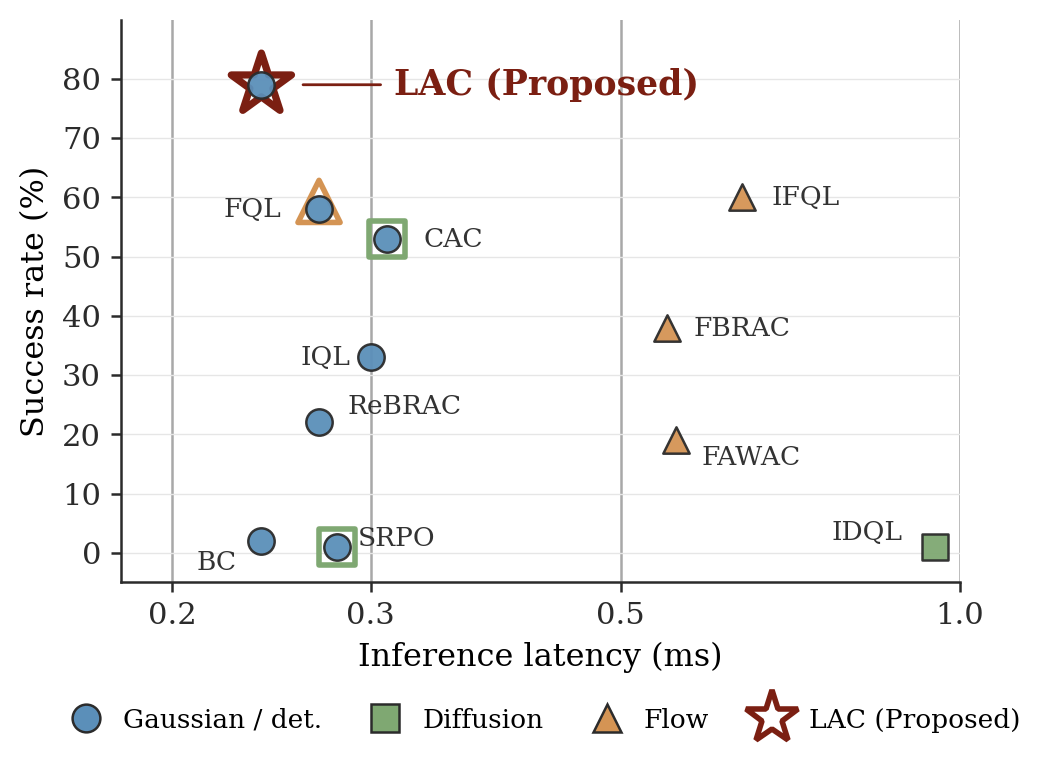
humanoidmaze-medium. Iterative generative actors (IDQL, IFQL, FBRAC, FAWAC) require multiple denoising or flow-integration steps per action. LAC (star) acts in a single forward pass, reaching a higher success rate at lower latency.Rather than making expressive actors cheaper, LAC asks whether they’re necessary at all once the critic is strong enough. A single forward pass through a small MLP produces each action.
Naively deepening an MLP critic destabilizes value learning. The failure isn’t one problem—it’s three, each on a different axis, each needing its own remedy. No single ingredient is sufficient.
Gradients fail to propagate through many layers—vanishing gradients, dead activations, ill-conditioned Hessians.
A deep critic fits its own noisy predictions; the 1-step bootstrap folds that noise back into the target every iteration, compounding errors.
Unbounded MSE lets Q-values drift off any reasonable scale, causing abrupt mid-training collapse after hundreds of thousands of healthy steps.
We evaluate on 7 challenging environments spanning long-horizon locomotion navigation (antmaze, humanoidmaze) and multi-step / combinatorial manipulation (scene, puzzle), for 35 tasks in total (5 goals per environment).
antmaze) and a 21-DoF whole-body humanoid (humanoidmaze) on shared layouts; manipulation spans pick-place / tool-use (scene) and sliding-tile puzzles (puzzle).hum-large, the full LAC recipe climbs from near zero at 4–8 layers to ~80% at depth 32, while plain-MLP and residual-only baselines plateau or fail.hum-large: all horizons fail while the critic is shallow, but the rows separate from depth 16 onward—n ≥ 2 stays stable while n = 1 degrades with further depth, evidencing the bootstrap-noise mechanism.hum-large. The shallow 4-layer critic (left) is blurred; the 32-layer LAC critic (right) yields a sharp gradient aligned with distance to the goal (star).Swapping in the LAC critic—while keeping each baseline’s original actor and policy-extraction objective—consistently boosts performance on hum-medium (task1): TD3+BC +36, FAWAC +24, FQL +38, IDQL +30, CAC +59. The inference savings aren’t paid for by an algorithm restriction; the same recipe accelerates and improves a broad family of methods.
@inproceedings{kang2026simple,
title = {Simple Actors and Deep Critics for Scalable
Reinforcement Learning},
author = {Kang, Guhyeon and Lee, Jaehwi and Kwon, Minhae},
booktitle = {Proceedings of the 35th ACM International Conference
on Information and Knowledge Management (CIKM '26)},
year = {2026},
doi = {10.1145/3799682.3840726}
}